ISG Vertical Pipeline Centrifugal Pump application limitation analysis
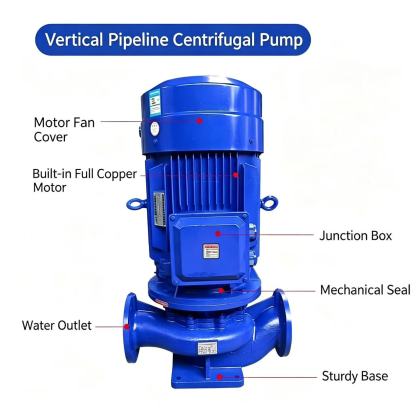
Even with widespread adoption in general fluid transfer systems, an ISG vertical pipeline centrifugal pump carries inherent application limitations that experienced engineers must evaluate before final system design. These constraints are not failures of the equipment itself, but natural tradeoffs derived from its vertical inline structure, shaft arrangement, and typical installation geometry. Overlooking these boundaries often leads to unexpected operational issues that become difficult to correct after the unit is already in service.
High Temperature and Thermal Expansion Constraints
Vertical inline design places the motor directly above the pump casing, creating a continuous vertical thermal path that transfers heat upward into the motor winding and bearing assembly. When handling high temperature media, uneven thermal expansion across the rotating stack can introduce subtle shaft misalignment that does not appear during cold alignment checks. This effect becomes more pronounced when operating far above ambient temperature, potentially causing increased vibration, accelerated seal face wear, and unexpected changes in bearing preload. Even with heat insulation measures applied to the casing, sustained extreme temperature conditions can push the standard material selection and thermal compensation design beyond its reliable operating envelope.
Heavy Duty High Head Operating Limits
As total system head increases, the vertical pump shaft must absorb progressively higher axial thrust loads without the benefit of the large, independent thrust bearing arrangements commonly found on heavy-duty horizontal centrifugal pumps. The compact integrated structure that makes vertical inline units space-efficient also limits the physical size and load capacity of the thrust bearing assembly. Under sustained high head operation, cumulative axial force can cause premature bearing fatigue, shaft deflection, and uneven contact across mechanical seal faces. This makes the configuration less suited for continuous high head applications where a robust, separately supported horizontal pump design would distribute thrust loads far more reliably.
Suction Side NPSH and Installation Height Restrictions
Since the impeller is positioned close to the horizontal pipeline centerline in most standard vertical inline configurations, the available NPSH margin can become extremely sensitive to installation elevation above the liquid source. Even a relatively small increase in mounting height or minor suction line friction loss can push the operating point into cavitation territory. Unlike certain horizontal pump layouts that allow more flexible positioning of the impeller relative to the suction vessel, the inline vertical geometry offers limited room for adjusting suction path hydraulics without major piping rework. This constraint becomes especially critical when handling warm liquids, volatile fluids, or systems where suction pressure varies significantly during different operating modes.
Solid Content and Abrasive Fluid Handling Boundaries
The narrow internal clearances around the impeller and seal chamber in a typical vertical pipeline centrifugal pump leave very little tolerance for abrasive solid particles carried in the process fluid. Even low concentrations of fine grit can cause rapid erosion of seal rings, impeller vane edges, and the shaft sleeve surface. Once these clearances begin to open up, internal recirculation inside the casing increases sharply, hydraulic efficiency drops off, and vibration levels start to rise. The vertical orientation also means heavier solid particles tend to settle near the bottom of the casing during idle periods, creating a risk of impeller jamming or severe abrasive wear during the next startup cycle.
Severe Cyclic and Frequent Start-Stop Conditions
Frequent starting and stopping under full system pressure places repeated shock loads on the short, stiff vertical shaft and the thrust bearing assembly. Each startup event subjects the rotating stack to sudden torque transients and rapid shifts in axial force that were not anticipated in moderate cycle service designs. Over thousands of such cycles, these repeated load reversals can lead to fastener loosening, fretting corrosion at key mounting interfaces, and early degradation of the mechanical seal’s secondary elastomer elements. For applications that demand hundreds of start-stop cycles per month, the accumulated fatigue can reduce service life far below the typical expectations derived from steady-state continuous operation.
Recommend
-

-

QQ Zone
-

Sina Weibo
-

Renren.com
-

Douban